Parotidectomy Procedure - Salivary gland surgery
Head and Neck Procedure
An overview of a Parotidectomy
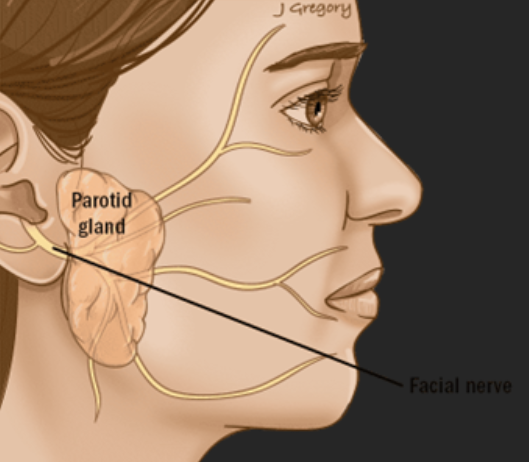
The parotid glands are glands that make saliva and are found on each side of the face, in front of the ears (see diagram below). They are not the only salivary glands.
The parotid gland is special because the nerve that controls the muscles of the face runs through the gland.
This nerve is called the facial nerve and controls the muscles that:
- Raise eyebrows
- Close eyes
- Smile and frown
- Stop food from leaking out of the mouth
Why is surgery (parotidectomy) needed?
A parotidectomy is most often done to remove a tumour from the parotid gland. Most parotid tumours are benign, but cancers also grow in the parotid and are more likely to affect the facial nerve.
The tumour together with an area of normal-appearing tissue is removed, to reduce the chance of any tumour cells being left behind. If the tumour is a cancer, then sometimes the lymph nodes in the neck will also be removed at the same time. This is called a neck dissection. You may want to download information on neck dissection, which is available on the Head and Neck Cancer Australia website.
If a cancer is large or affects the facial nerve, then sometimes the bone behind the ear needs to be removed and/or reconstructive surgery is necessary. More information regarding this can be found in facial nerve sacrifice, temporal bone resection and free flap reconstruction.
Parotid surgery, also known as a parotidectomy, is the standard form of treatment for most parotid tumours and involves the removal of part or whole of the parotid gland. Depending on the size and severity of the tumour, parotidectomy surgery is categorised as either superficial or total.
Superficial Parotidectomy
A superficial parotidectomy is used when the tumour growth is limited to the superficial lobe of the parotid gland. During the procedure, all or a part of the affected superficial lobe is removed, along with some surrounding tissue.
Total Parotidectomy
For parotid tumours located in the deep lobe of the parotid gland, a total parotidectomy may be recommended to remove the deep lobe and, if necessary, part of the superficial lobe (usually for access).
In both types of parotidectomy surgery, protection of the facial nerve is critical. The facial nerve traverses the middle of the parotid gland and is responsible for frowning, eye closure, nose wrinkling, smiling, and lip movement. During surgery, Dr Kelly uses nerve integrity monitoring (NIM) – a device that allows her to monitor the function of the facial nerve during surgery. This ensures that the nerve is protected and minimises the risk of resulting weakness in the facial muscles. In exceptional circumstances, this is impossible due to the location or size of the tumour.
What are Parotid Tumours?
Parotid tumours, or salivary gland tumours, are growths of abnormal cells in the gland, or in the duct that drains the salivary glands.
While relatively uncommon, there are three main symptoms that are experienced with parotid tumours:
- Swelling in the face and jaw (usually painless, and by far the most common)
- Loss of facial movement (this can indicate a serious diagnosis)
- Difficulty swallowing (very rare)
Types of Parotid Tumours
Most parotid tumours are benign (non-cancerous). Benign tumours include:
- Pleomorphic adenoma (most common)
- Warthin's tumour (occurs commonly in older men who smoke)
- Oncocytoma and other rare tumours
Some parotid gland tumours are malignant (cancerous).
Malignant tumours include:
- Metastasis from skin cancers
- High and low-grade mucoepidermoid carcinoma
- Salivary duct carcinoma
- Squamous cell carcinoma
- Acinic cell carcinoma
- Adenoid cystic carcinoma
Parotid tumours are diagnosed following an ultrasound-guided fine needle aspiration (FNA) in which cells are removed for testing. Imaging, such as an MRI or CT scan, may be used to check the size of the tumour and whether it has spread to nearby tissue or lymph nodes in the neck or involved the facial nerve.
Possible Side Effects and Management
As with all operations, there is a chance that parotidectomy may lead to several side effects. You may not experience all the side effects. Speak with your doctor if you have any questions or concerns about treatment side effects.
Side effects common for parotidectomy may include:
- Nausea: General anaesthetic may cause nausea. This will settle down soon after the operation and can be treated.
- Sore throat: Your throat may be sore initially because of the breathing tube placed during the operation.
- Numbness near the ear: After the operation, the skin on the side of the face and in front of the ear will be numb for some time. This gradually improves over months, but the ear lobe usually stays numb.
- Bleeding or bruising: There may be a blood clot or bruise underneath the skin in the area of the surgery. Occasionally an operation may be needed to remove this.
- Pain when eating: In a very small number of people, parotidectomy causes 'first bite syndrome'. This is pain with the first bite of a meal. It usually gets better over time.
- Gustatory sweating: Sweating on the operated side of the face.
Rare Side Effects
- Facial weakness
Recovery and Aftercare
- Immediate recovery: A hospital stay of 1 to 2 days is typical. A small surgical drain may be placed in the wound, which is usually removed within 1 to 2 days.
- Diet and activity: Normal diet. Strenuous exercise and heavy lifting are restricted for about two weeks.
- Timeline: You can usually return to work or driving within 1 to 2 weeks, provided you are no longer taking prescription pain medication. Full sensation in the face and ear can take several months and occasionally up to a year to completely return.