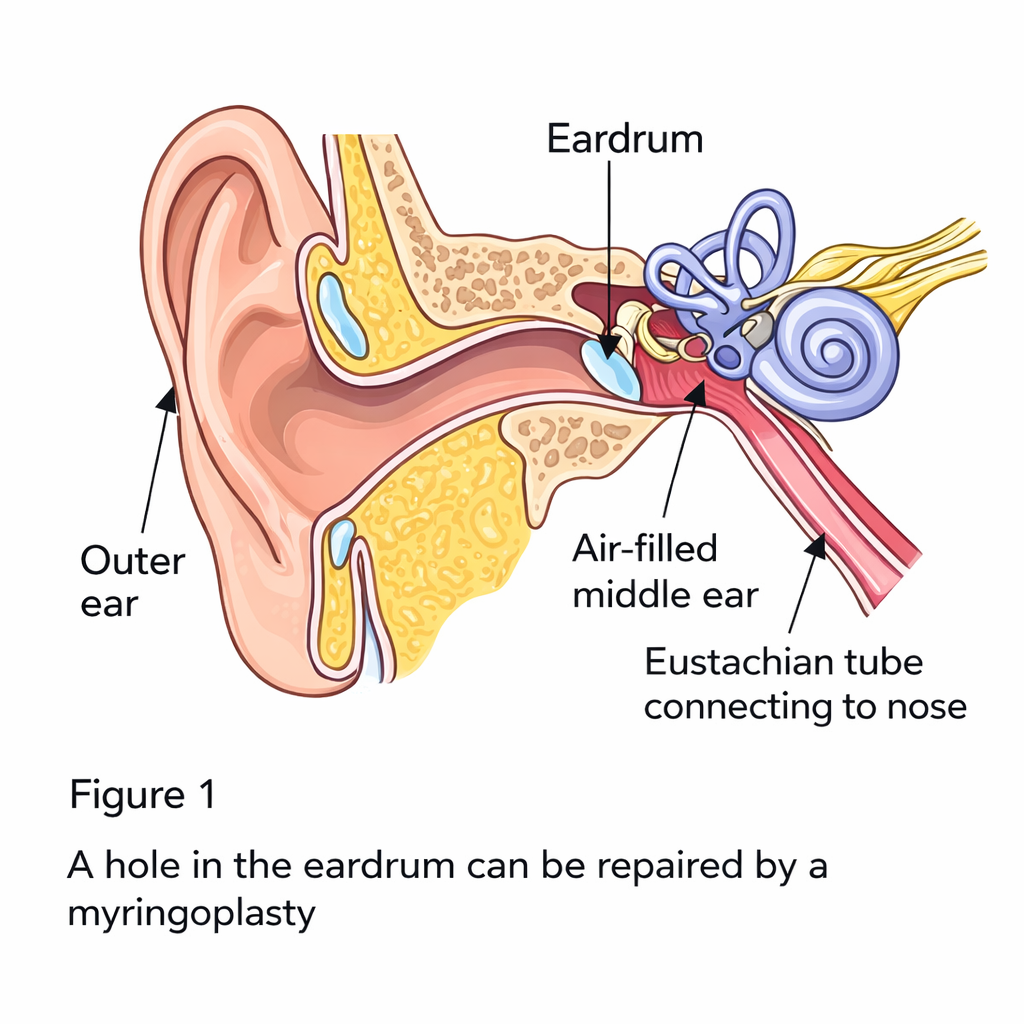
Myringoplasty
A myringoplasty is a surgical procedure performed to repair a hole (perforation) in the eardrum (tympanic membrane) using a tissue graft, aiming to improve hearing, prevent recurrent ear infections and/or protect the middle ear.
Why surgery?
In most cases, a ruptured eardrum heals on its own in just a few weeks. Your healthcare provider may recommend myringoplasty when you or your child:
- Has a ruptured eardrum that hasn’t healed within three months.
- Has chronic or recurring (returning) ear infections.
- Has hearing loss due to a ruptured eardrum.
- Sustains trauma that results in a perforated (torn) eardrum.
The operation
A surgeon uses a graft (tissue) to cover the hole, often placing it underneath the eardrum via the ear canal or an incision behind/in front of the ear. This procedure usually takes 60–90 minutes.
Risks
Although rare, risks include infection, failure of the graft to take (perforation recurs), taste disturbance, or, in very rare cases, facial nerve weakness.
Recovery
- Hospital stays: Usually same-day discharge.
- Bandaging: A dressing or bandage is used, which may have minor blood drainage.
- Care: The ear must be kept dry for several weeks.
- Activity: Light duties and walking are encouraged after 24–48 hours, but strenuous lifting or heavy exercise should be avoided for 2+ weeks.
- Travel: No flying for 6 weeks.
Post-operative instructions
You will be given instructions for post-operative care prior to your surgery.
When to contact a doctor
If you experience:
- Severe or increasing pain not relieved by medication.
- Large amount of bleeding or foul-smelling, thick pus-like discharge.
- Severe or persistent dizziness.
- Facial muscle weakness or numbness.